Study on sustainable finance: accredited certifications and market confidence

Certifications are not merely compliance tools: they promote growth and competitiveness, offer measurable benefits for corporate sustainability, and make a concrete contribution to the quality of information used by financial markets.
In recent years, the evolution of European regulation and investors’ growing focus on environmental, social, and governance (ESG) issues have made the availability of reliable, comparable, and verifiable information increasingly crucial.
In this context, the Quality Infrastructure — and, in particular, accreditation and accredited certifications — play a strategic role in strengthening the credibility of the information used by companies, banks, investors, and institutions.
These are the main findings that emerged from the Accredia “Osservatorio” study, conducted in collaboration with Prometeia, “The Role of Accredited Certification in Sustainable Finance” . The analysis offers an in-depth examination of the contribution that the Quality Infrastructure can make toward achieving sustainability goals, highlighting not only the economic benefits associated with certifications but also their impact on the environmental and social performance of companies.
The regulatory and economic context
The transition toward more sustainable development models requires tools capable of ensuring transparency, reliability, and trust. The European Union has progressively built a regulatory framework aimed at directing capital toward activities consistent with climate and social objectives, introducing tools such as the European Taxonomy, ESG disclosure rules, ESG rating regulations, and standards for green bonds. However, the effectiveness of this system depends on the quality of the available information. For markets to accurately assess risks and opportunities, the data used must be credible and verifiable. This is precisely where accreditation plays a role.
By verifying the competence and impartiality of bodies that perform conformity assessment activities, accreditation helps ensure the reliability of certifications and, more generally, of the information that informs the decision-making processes of companies and financial operators. Accredited certifications thus become a tool that allows organizations to demonstrate, in an objective and verifiable manner, their compliance with specific internationally recognized requirements and standards.
The growth of certified management systems
The study highlights the growth of accredited certifications in recent years within the Italian business sector: between 2012 and 2025, the number of companies with at least one accredited certified management system rose from approximately 75,000 to over 100,000.
Although they represent a limited share of the total number of active companies in the country, these organizations carry particularly significant economic weight. In fact, certified companies generate over 40% of the total revenue of the Italian production system, confirming that the spread of certifications affects a significant portion of the national economy.
Accredited ESG certifications
Particularly evident is the progressive strengthening of the ESG dimension within the landscape of accredited certifications: by 2025, certifications related to environmental, social, and governance issues will account for nearly all certifications adopted by companies. Although the governance component continues to be predominant—thanks to the widespread adoption of the associated UNI EN ISO 9001 certification—a growing focus on environmental and social aspects is clearly emerging.
This phenomenon reflects both the evolution of the European regulatory framework and the new market demands, which place increasing value on companies’ ability to manage the various dimensions of sustainability in a structured manner.
The effects on economic performance
One of the most innovative aspects of the study concerns the analysis of the effect of certifications on corporate performance. On average, certified companies perform better economically than non-certified ones, but the study goes beyond simple descriptive observation, seeking to understand whether these differences are attributable exclusively to the companies’ pre-existing characteristics or also to the adoption of the certifications themselves.
The results indicate a positive relationship between accredited certifications and economic performance. In particular, the introduction of ESG certifications in companies already certified to UNI EN ISO 9001 is associated with significant increases in revenue that are already evident in the year of certification and tend to consolidate over time.
For companies that adopt UNI EN ISO 14001, for example, the estimated effect corresponds to a revenue increase:
- 4.3% in the year of certification
- 8.4% one year later
- 11.4% two years later.
Similar positive effects are observed for UNI EN ISO 45001, for UNI/PdR 125 on gender equality, and for ISO/IEC 27001 on information security.
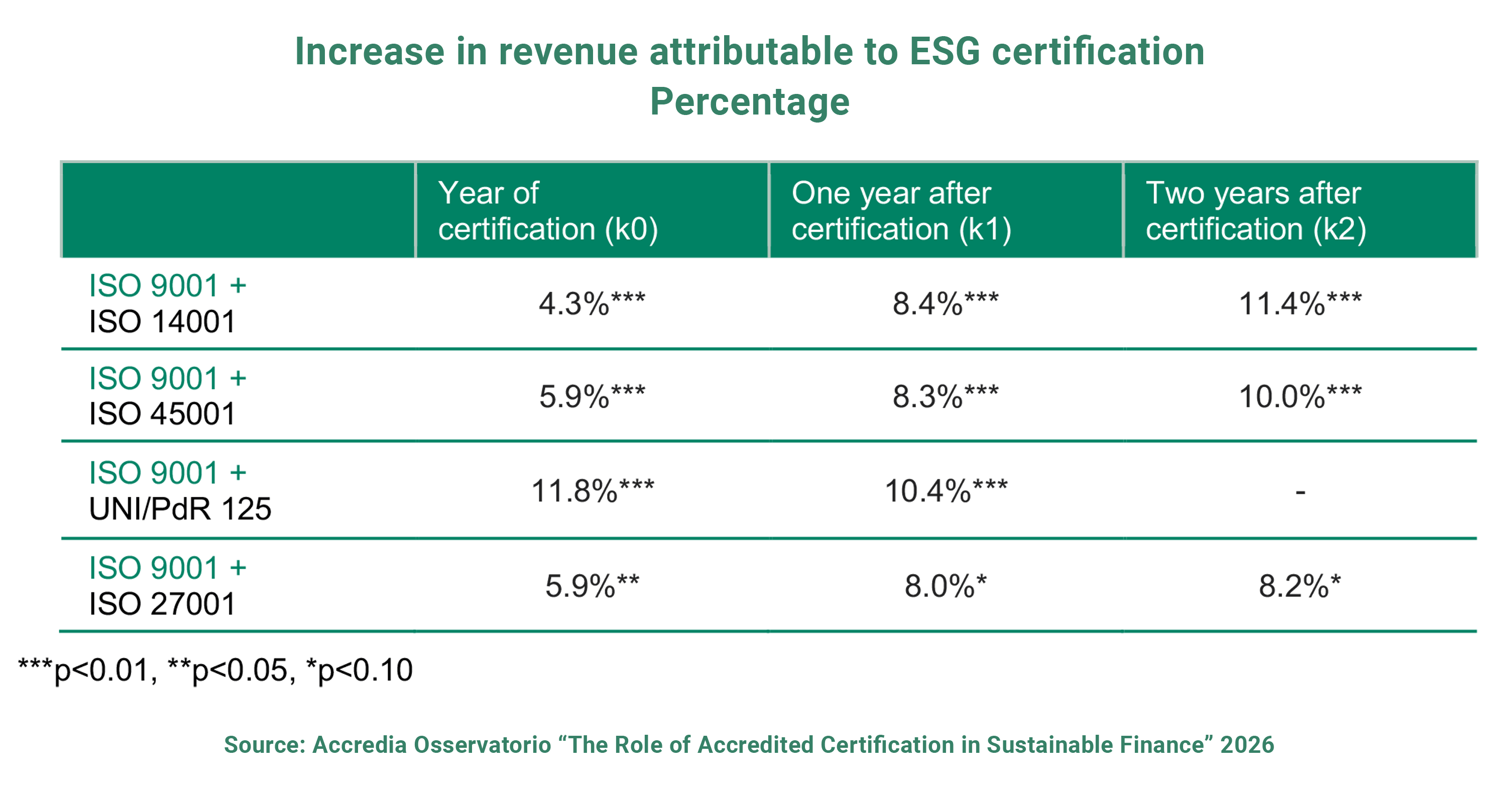
The evidence therefore suggests that accredited certifications are not merely a tool for regulatory compliance or a reputational signal to the market, but can make a tangible contribution to improving business competitiveness.
The internal and external benefits of certifications
Certifications generate value through a variety of mechanisms:
- Internally, they promote better process organization, enhanced performance monitoring capabilities, and more effective risk management
- Externally, they help strengthen corporate reputation, reduce information asymmetries, and facilitate access to markets, supply chains, and sources of financing.
In other words, accredited certification serves a dual purpose: on the one hand, it acts as a management tool that supports the continuous improvement of organizations (it is no coincidence that its impact on revenue increases over time); on the other hand, it serves as a guarantee of reliability for stakeholders, customers, investors, and the financial system. This function appears particularly relevant at a time when the quality of ESG information increasingly influences access to credit and investment decisions.
Effects on sustainability performance
The study also highlights positive effects on companies’ sustainability performance. ESG certifications are associated with improvements in environmental, social, and governance indicators, albeit with varying timelines and degrees of impact. The environmental dimension shows the fastest and most substantial effects, with improvements that tend to increase over time. The social and governance components also show significant progress, albeit through more gradual processes, consistent with the nature of the required organizational changes.
These results confirm that certifications can help make companies’ sustainability initiatives more structured, measurable, and verifiable. Their value, in fact, extends beyond simply certifying compliance with specific requirements; it lies in their ability to foster more effective information management, greater process traceability, and more transparent communication with stakeholders.
The value of environmental and social benefits
Another point of interest concerns the economic quantification of the environmental and social benefits associated with accredited certifications.
According to estimates from the study, over the 2012–2024 period, the estimated reduction in environmental costs associated with accredited certifications amounts to approximately 36 billion euros, while, on the social front, accredited certifications generated benefits totaling 6.6 billion euros. In 2024 alone, the environmental and social benefits attributable to accredited certifications totaled approximately 5.5 billion euros.
Within the environmental component, the most significant contribution relates to climate change mitigation and the reduction of environmental impacts. On the social front, the effects related to employment, inclusion, and the promotion of equal opportunities are of particular importance. These results allow us to broaden our perspective beyond traditional economic and financial measures, offering a more comprehensive assessment of the value generated by certifications for the economic system and the community.
Conclusions
The study’s conclusions are particularly relevant in light of the challenges currently facing sustainable finance. The growing focus on ESG disclosures and the need to combat greenwashing and social washing require tools capable of ensuring transparency and reliability.
In this context, the Quality Infrastructure emerges as an essential element in supporting sustainability policies. Through accreditation and accredited certifications, companies can make their processes more structured and verifiable, while investors, institutions, and markets can rely on more credible, consistent, and verifiable information.
The study thus confirms that accredited certifications are not merely technical tools for assessing compliance, but genuine drivers of development capable of guiding companies toward more sustainable growth models.
Key messages
-
Over 100,000 organizations certified
by bodies accredited by Accredia -
A 4.3% increase in revenue
resulting from obtaining a UNI EN ISO 14001 management system certification under accreditation -
36 billion euros in environmental and social benefits
estimated, attributable to accredited certifications during the 2012–2024 period
Publication
The role of accredited certification in sustainable finance
The study presented by Accredia analyzes the role of accredited certification for competitiveness, as a tool to support the quality, verifiability, and comparability of ESG data, with positive effects on company performance.